
Digital Storytelling: Pedagogical Foundations
 | Action-oriented Approach|Plurilingualism|Tech-mediated
How does Digital Storytelling align with the Action-oriented Approach? 🧠
Digital Storytelling (DST) aligns with the Action-oriented Approach (AoA) by engaging learners in real-world communicative tasks. Students become social agents who use their languages, cultural backgrounds, and digital tools to accomplish meaningful tasks, such as creating and sharing a story. DST supports plurilingualism by encouraging learners to draw from their full linguistic, cultural, and semiotic repertoires to express themselves using digital tools.
You can integrate DST into task-based or project-based learning units. A great starting point is exploring students’ personal narratives. Ask them to include words, phrases, and cultural references from their linguistic and cultural backgrounds. Alternatively, teachers can also design collaborative DST projects, assigning specific roles such as editor, designer, narrator, or tech assistant.
DST fosters
- Learner Autonomy
- Collaboration
- Real-World Connections (See AALE infosheet Introduction to the Action-oriented Approach and Council of Europe video on The action-oriented approach (2022))
- Students’ Voice and Agency (See AALE infosheet Action-oriented Approach in Practice)
- Translanguaging (See AALE infosheet Plurilingual Pedagogical Practices and PlurilingualLab video on Translanguaging)
- Cross-cultural and Cross-linguistic Understanding (See AALE infosheet Plurilingual Pedagogical Practices and PlurilingualLab videos on Cross-linguistic analysis and Cross-cultural comparisons)
How to integrate DST in the L2 classroom 🧩
1. Analyze your context:
Explore the affordances and challenges specific to your context. Consider your learners’ ages, group composition, languages spoken, and cultural backgrounds. This will help you adapt DST tasks to your curricular goals, lesson plans, and learning outcomes.
2. Define goals and learning outcomes:
Clearly define the general and specific goals of the lesson, activity, or project. Use “can-do” statements and align them with CEFR descriptors for language proficiency. See AALE infosheet Exploring and Selecting Descriptors.
Examples:
- (B1): Can produce straightforward connected texts on a range of familiar topics within their field of interest, linking shorter elements into a cohesive sequence.
- (C1): Can employ the structure and conventions of various genres, adjusting tone, style, and register to suit the audience, text type, and theme.
3. Decide on individual or group format:
If the task is individual, keep it simple and encourage students to share their stories in small groups.
For group projects, assign or let students choose specific roles (tech support, editor, designer, narrator, etc.) to promote agency and collaborative work.
4. Plan for tech resources and time
Identify the tools available (computers, tablets, smartphones, apps), and organize the project in phases (e.g., brainstorming, drafting, editing, media production). Allocate sufficient time to ensure students can reflect and incorporate cultural and linguistic elements, drawing from students’ backgrounds into their stories.
5. Encourage multimodal creativity
Have students explore websites and apps that allow them to include images, audio, video, music, and subtitles in multiple languages. This enhances creativity and reinforces the message through multimodal literacy.
Remember: DST is a means to an end. Its main purpose is to promote language development while fostering intercultural awareness, cross-cultural, and crosslinguistic understanding. Ensure the project is well-structured and includes:
- Clear goals
- Task stages (brainstorming → researching → scripting → storyboarding → selecting/creating images, audio, videos → editing → sharing)
- Evaluation rubrics/guidelines, and space for peer feedback and critical reflection.
Steps for students to develop DST in class 👣
The following infographic by Samantha Morra outlines the main stages of DST development:
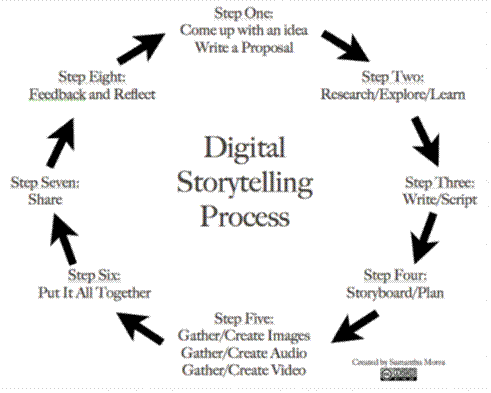
- Brainstorm ideas: Help students connect their ideas with curriculum goals. Explore their cultural and linguistic identities.
- Research: Encourage them to search for relevant and accurate information online.
- Draft the story: Develop the narrative in simple written form.
- Write the script: Convert the story into a script for narration.
- Storyboard: Plan each scene visually, connecting it to the narrative.
- Focus on the message: Keep the story’s key message clear and consistent.
- Create or collect media: Use or produce images, video, and audio.
- Edit the story: Use editing software (free and accessible) to assemble the final product.
- Cite all sources: Acknowledge any external content (images, music, etc.).
- Share the story: Choose a format and platform to publish the final piece.
- Provide and receive feedback: Organize peer review sessions and allow students to present their work to classmates, families, or (online) communities.
Potential challenges and solutions 🚨ℹ️
Time constraints: Break the project into smaller, manageable phases. Allocate in-class and out-of-class time accordingly.
Technical issues: Choose intuitive, user-friendly tools. Pair tech-savvy students with peers who need support. Consider training sessions or tutorials before starting the project.
Learn more ➕
- Video: What is Digital Storytelling
- CEFR Companion Volume (Implementing AoA)
- Council of Europe (Plurilingual and Pluricultural Competence)
AALE Toolkit Homepage | Action-oriented Approach | Plurilingualism | Tech-mediated | AALE Infosheets Exploration