
Understanding AI Prompts
 | Action-oriented Approach|Plurilingualism|Tech-mediated
What are AI prompts? 🧠
AI prompts are short written instructions/questions that guide a generative AI tool (or large language model) —like ChatGPT—to generate a response. Think of a prompt as a request or command, the clearer and more detailed it is, the better the AI tool can understand what you want. For example, a basic prompt like “Create a vocabulary list for food in Spanish” might give you a list of common words, while a more specific one – “Create an A2 level dialogue in Spanish between two people ordering food in a restaurant, with English equivalents” – can generate a ready-to-use classroom activity. In language teaching, well-crafted prompts (i.e., effective prompt engineering) can help create texts, lesson plans, cultural learning scenarios, and/or plurilingual activities, saving time and sparking ideas.
A cautionary note: Large Language Models (LLMs) learn to generate text from extensive self-training and specific data, but their output requires continual critical evaluation due to potential biases or inaccuracies in their training. Well-crafted AI prompts, using critical AI digital literacy, guide these models to create language teaching resources, offering efficiency and new ideas for educators.
Some benefits of AI prompts in language teaching ⬆️
- Save time on planning.
- Brainstorm lesson ideas/activities and explore new options, expanding thinking about language teaching practice.
- Generate creative activities/scaffolding (dialogues, role-plays, assessments).
- Personalize lessons for different contexts, language backgrounds, proficiency levels, individual students.
Basic framework for crafting effective prompts ✍️
- Be clear and specific in your requests.
- Use action verbs (e.g., “generate,” “create,” “adapt”).
- Define learning objectives.
- Provide detailed context (e.g., target language, topics, proficiency level).
- Assign a role to the AI (e.g., “Act as a French teacher preparing an A2-level lesson”) to shape tone and pedagogical structure.
- Use iterative prompting (i.e., refine your prompts based on AI’s output).
Examples
Example 1 – Vague/Unclear prompt
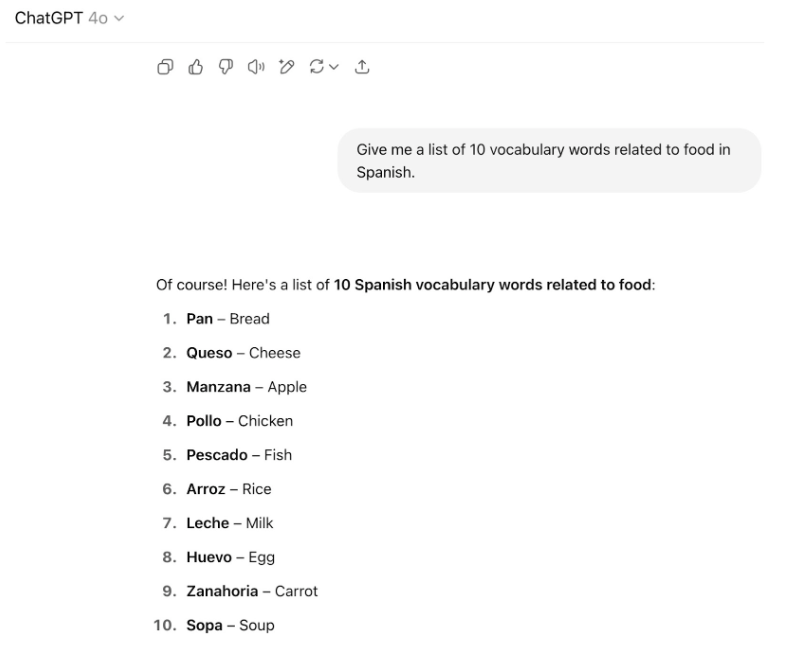
Result: A list of isolated vocabulary terms with no clear pedagogical use or context.
Example 2 – Effective prompt
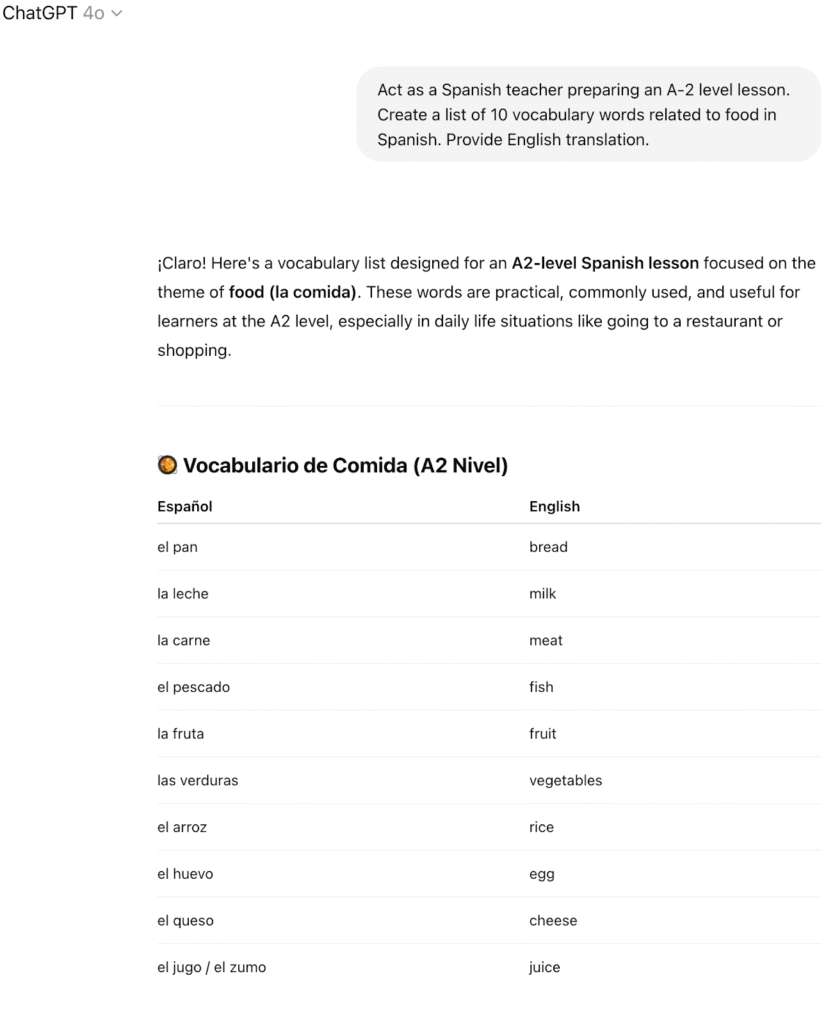
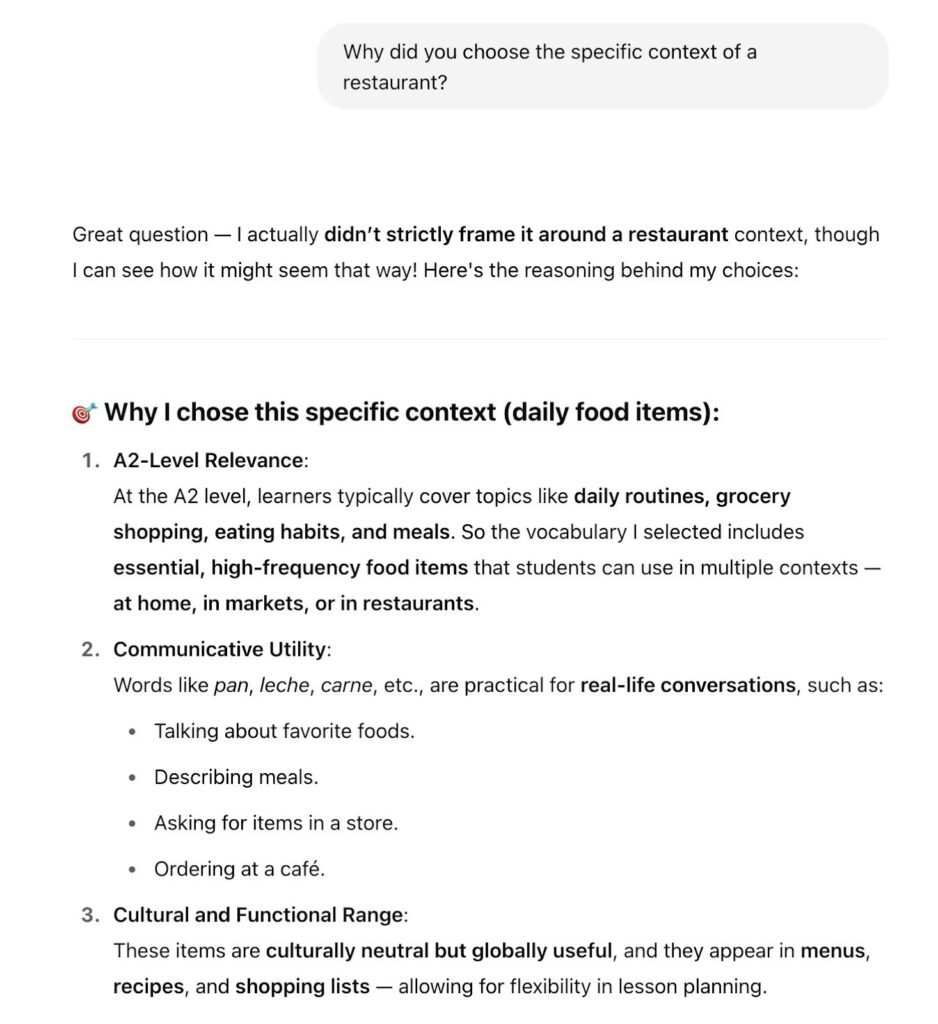
Result: A contextualized, communicative activity that can be used directly in class and supports multiple skills (listening, reading, translation).
More useful resources ➕
- Brief video reviewing Large Language Models
- How to craft compelling AI prompts for language teaching
- ChatGPT for Language Teachers
With this understanding of AI prompts, feel free to explore more about prompt engineering to help with plurilingual language teaching/lesson planning in Effective AI Prompt Engineering for Plurilingual Pedagogy
AALE Toolkit Home | Action-oriented Approach | Plurilingualism | Tech-mediated | AALE Infosheets Exploration