
CEFR & Language Learning and Use
 | Action-oriented Approach|Plurilingualism|Tech-mediated
How does the CEFR see language learning and language use? 🧠
The CEFR models language proficiency as the process of mobilizing, combining (and so extending) competences and strategies in the process of carrying out a particular task, which usually involves various language activities (like reading, interacting with someone else, writing notes, etc.).
The CEFR ‘descriptive scheme’ sees competences in terms of:
- general competences (like knowledge of the world and intercultural competence), and
- language competences (linguistic: grammar and vocabulary; pragmatic: functional ability, familiarity with types of discourse; and sociolinguistic: appropriateness in context).
In terms of activities—and related communicative strategies—the CEFR moves beyond the ‘four skills’ (listening, speaking, reading, and writing), which were introduced in the early 1960s and are the spoken/written modes of Reception and Production. After all, there are types of reception and production that are not just spoken or written (e.g., watching a film). The CEFR adds to these two classic categories of activity two new integrated categories that combine and go beyond them:
- Much, if not most, of the time, language use involves Interaction (e.g., in conversation, in exchanging messages, in collaborating online, in multimodality).
- Finally, language use often involves more than just communication; we are often doing something specific through language (understanding something; collaborating with others to think something through and/or construct an idea or design; helping or repairing communication itself). These are forms of Mediation, which usually involve more than one of the other modes of communication (reception, production and interaction).
The CEFR descriptive scheme is visualized in Figure 1.
Figure 1—The structure of the CEFR descriptive scheme
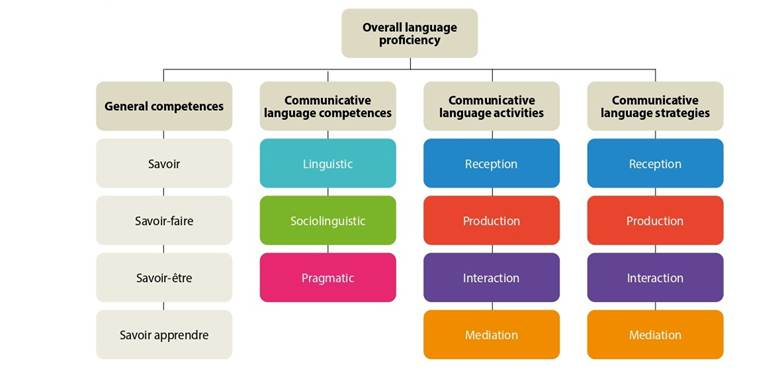
From the ECEP project publication. Piccardo, E. et al. (2021). Pathways through assessing, learning and teaching in the CEFR, Council of Europe Publishing, Strasbourg, available at https://www.ecml.at/en/Resources/ECMLresources/ID/28
Read this extract from the ECEP publication mentioned above [1] (pp. 37-40), which explains in more detail the way competences are described in the scheme:
“Communicative competence includes many competences which people acquire throughout their lives. The CEFR emphasizes that learners in a (school) learning situation already draw upon a number of competences, which belong to their cultural background and experience. Such competences can be more or less closely related to language or linguistic competence. Learners’ prior knowledge—which needs to be valued—and progressive achievements contribute to the aim of “becoming more competent.”
| General competences | Communicative language competences | |||||
| Declarative knowledge | Skills and know-how | Existential competence | Ability to learn | Linguistic competences | Sociolinguistic competence | Pragmatic competences |
| knowledge of the world sociocultural knowledge intercultural awareness | practical skills intercultural skills | knowing how to be in a situation empathy | language and communication awareness general phonetic awareness and skills study skills heuristic skills | lexical competence grammatical competence semantic competence phonological competence orthographic competence orthoepic competence | social relations politeness conventions expressions of folk wisdom register differences dialect and accent | discourse competence functional competence |
Table 1. Schematic organisation of competences according to the CEFR
General competences from an intercultural perspective 🌏🔠
Learners already possess general competences, which increase at school, including declarative knowledge (savoir), skills and know-how (savoir-faire), existential competence (savoir-être), and the ability to learn (savoir-apprendre).
Declarative knowledge includes learners’ “knowledge of the world” (CEFR, p. 101), which embraces knowledge of people, locations, and characteristics of the country or countries in which the target language is spoken. Knowledge of a society and a country cannot be acquired by users without developing sociocultural knowledge as well as intercultural awareness. The former consists of the knowledge of “features distinctively characteristic of a particular European society” (CEFR, p. 102), which may relate to everyday life, living conditions, interpersonal relations, values, beliefs and attitudes, body language, social conventions, and ritual behaviour. Certain features may be “traditional”—for instance, institutions, history, or politics—but there are also features that are seldom obvious, such as social conventions. When hosting visitors from abroad, there are many social conventions, such as punctuality, expectations for gifts, length of stay or leave-taking that constitute appropriate interpersonal relationships. Behavioural and conversational conventions are also integral, as are taboos, ritual behaviour, religious observances and rites, festivities, and celebrations. In addition, nonverbal communication and body language are important.
Knowledge of intercultural features and the capacity to relate them to one’s own world and the world of the target community produce intercultural awareness, which is essential for developing European citizenship. Intercultural awareness includes the capacity to reconsider one’s own culture and to be open-minded towards foreign cultures. The CEFR stresses that sociocultural awareness is not necessarily included in learners’ previous experiences, or, if it exists, it may be influenced by stereotypes. Learning at school is therefore very important for developing appropriate intercultural knowledge.
Relevant skills and knowledge include “intercultural skills and know-how,” such as “cultural sensitivity” (CEFR, p. 104) and the ability to identify a variety of strategies in a particular situation. These intercultural skills and know-how call upon learners’ capacities to build upon contacts with a foreign culture to fulfill the role of intercultural intermediary between the home and the target culture, thereby overcoming stereotyped relationships and possible conflict situations. Linguistic or intercultural misunderstanding can relate, for instance, to politeness conventions and register. Although solutions for linguistic errors or mistakes may easily be found, intercultural misunderstandings may give rise to negative attitudes toward other people, which are much more difficult to overcome. Learners therefore require appropriate knowledge as well as skills and know-how to deal with intercultural situations in the real world. Indeed, learning and teaching activities often focus more on the acquisition of linguistic competence than on learners’ intercultural competence.
Each learner has a personal identity characterized by attitudes, motivations, values, beliefs, cognitive styles, and personality types. A taciturn, shy, and introverted learner will act in a different way towards other people than a loquacious, enterprising, and extroverted one. The development of one’s personal identity is an important goal. Awareness and aptitudes for learning underpin the construction of an “intercultural personality” (CEFR, p. 106) that takes into account different personality types.
“Ability to learn” means the aptitude to observe new experiences and to incorporate them into one’s own knowledge of the world, modifying it if necessary. The ability to learn includes various components: language and communication awareness as well as general phonetic skills, on the one hand, and study skills and heuristic skills on the other (CEFR, pp. 106–107).
Sensitivity to language as a communication tool involves learners’ capacity to consider new experiences in the target language as an enrichment. These can enhance learners’ motivation as well. In a similar way, phonetic skills can help people to master their processes of language learning. Study skills underlie learners’ ability to organize and use materials for autonomous and self-directed learning in order to become increasingly independent in their language learning. Finally, heuristic skills include language users’ abilities to take advantage of new experiences and to be proactive in their own (inter)cultural learning.
Communicative language competence from an action-oriented perspective 🗣️⚙️
For communication to take place, people must put their general competences into practice. Communicative language competence, including linguistic, sociolinguistic, and pragmatic competences, allows communication to occur (CEFR, p. 108). Linguistic competence in turn includes “lexical, grammatical, semantic, phonological,, and orthographic competence[s]” (CEFR, p. 109).
Lexical competence overlaps with sociolinguistic competence. The knowledge of certain fixed expressions, such as greetings like “Good morning!”, consists of the knowledge and ability to use lexical elements, and these “linguistic markers,” such as greetings and sentential formulae (CEFR, p. 110), are in fact also “markers of social relations” (CEFR, p. 118). Such expressions and relations, as well as their use, differ for various languages and cultures and depend on many factors, such as status, closeness of relation, or register of discourse. Communication involves fundamentally sociolinguistic dimensions above and beyond purely linguistic elements.
Awareness of the relationships between the knowledge of a language as a whole and its social realisations can foster learners’ intercultural awareness, which, as observed above, is an essential competence among general ones. The choice of address forms such as “My Lord, Your Grace” (CEFR, p. 119) and the use of “O.K. Let’s get going” (CEFR, p. 120) involve not only lexical knowledge, but also the knowledge of the variety of languages, of different contexts, and of the users’ relative status.
Among linguistic competences, grammatical competence involves “the ability to understand and express meaning by producing and recognising well-formed phrases and sentences” (CEFR, p. 113). Sentences are not to be learnt by heart and repeated by learners, but on the contrary are tools for increasingly independent communication. Learners’ grammatical accuracy increases as they gain the ability to control their own communicative production. If an A2 learner still systematically makes basic mistakes, a B2 learner makes occasional “slips” or unsystematic errors and minor flaws may still occur in sentence structure as well (CEFR, p. 114).
Semantic competence is related to lexical competence, particularly concerning the relation of words to general context and inter-lexical relations. Vocabulary includes not only single words – which may have several distinct meanings (polysemy) – but also their combinations in fixed frames and phrasal idioms. This differentiation underlined by the CEFR proposes a contextualised lexical and grammatical learning, starting from fixed expressions and collocations, such as “to put up with” and “to make a speech” (CEFR, p. 111). A person’s extent of vocabulary knowledge and mastery is evaluated through appropriate scales, which underlie the importance of people having a (good) range of vocabulary to express themselves on most topics pertinent to their everyday life (A1>B1) and on most general topics (B2>C2) for matters connected to their field(s).
Sociolinguistic appropriateness often includes the word “awareness”: language users not only have to be aware of politeness forms and differences between the customs, values and beliefs prevalent in their own community and those of the target community, but they must also be able to produce them in a communicatively appropriate way. Looking for signs of the most significant differences between the two communities (B1), people are able to choose the register which is appropriate to the situation and can express themselves appropriately (B2).
Pragmatic competence is made up of “discourse competence,” “functional competence,” and “design competence” (CEFR, p. 123). The first competence includes, among others, the ability to manage discourse in terms of coherence and cohesion, logical ordering, style and register. The coherent use of register involves linguistic competence (knowledge of the right utterance) as well as sociolinguistic competence (learners’ ability to choose the right address form according to the relative status) and pragmatic competence.
Functional competence is concerned with communication complexity in terms of macro functions and micro functions. Among the first group are categories such as description, demonstration and argumentation; among the second are imparting and seeking factual information or communication repair. These competences focus on the functional use of spoken discourse and written texts. Learners’ abilities for “expressing and finding out attitudes” and of “socialising” (CEFR, p. 126) – which are micro functions of functional competence – relate directly to sociolinguistic competence. Design competence refers to sequenced messages “according to international and transactional schemata” (CEFR, p. 123). Learners’ abilities to use these schemata and structured sequences of actions such as question/answer or acceptance/non-acceptance allow them to take part in complex interaction situations, according to their purposes. These rather technical dimensions, along with social and organisational dimensions, combine to contribute to communicative acts. Communicative language competence involves a network of complex and articulated competences whose threads consist of general competence and communicative language competences, which are interdependent.” From Pathways through assessing, learning and teaching in the CEFR (pp 37-40).
Finally, to deepen your understanding of the CEFR descriptive scheme why not see how much of that you have taken in and try and do (alone or with your colleagues) the following tasks included in three worksheets from the Training kit produced within the same project. The first asks you to identify categories of general competence. The second asks you to sort out descriptors of communicative competences into linguistic, sociolinguistic and pragmatic competences respectively.
Task 1:
| Title: General competences |
| Objective(s): To understand the notion of general competences and the constituent parts |
| Task 1A (€) The CEFR defines four kinds of general competences. Classify in the scheme below keywords or short sentences linked to the different general competences you will find in the list: |
| declarative knowledge (savoir) |
| skills and know-how (savoir-faire) |
| “existential” competence (savoir-être) |
| ability to learn (savoir-apprendre) |
| 1 living standards 2 openness towards, and interest in, new experiences, other persons, ideas, peoples, societies and cultures 3 study skills 4 knowledge of locations, institutions and organisations, persons, objects, events, processes and operations in different domains 5 ability to perceive and catenate unfamiliar sound sequences 6 ability to make effective use of the learning opportunities created by teaching situations 7 ability to carry out effectively the routine actions required for daily life 8 family structures and relations 9 ability to use available materials for independent learning 10 willingness and ability to distance oneself from conventional attitudes to cultural difference 11 ability of the learner to come to terms with new experience and to bring other competences to bear in the specific learning situation 12 knowledge about everyday living 13 ability to identify one’s own needs and goals 14 capacity to fulfil the role of cultural intermediary between one’s own culture and the foreign culture 15 leisure skills 16 ability to incorporate new knowledge into existing knowledge 17 general phonetic skills 18 knowledge about national stereotypes 19 ability of the learner to find, understand and if necessary convey new information 20 knowledge of society and culture of target language communities 21 ability to use new technologies 22 communication awareness 23 knowledge, awareness and understanding of the relation (similarities and distinctive differences) between the ‘world of origin’ and the ‘world of the target community’ 24 cultural sensitivity 25 ability to observe and participate in new experiences 26 sensitivity to language 27 ability to distinguish and produce unfamiliar sounds and prosodic patterns 28 attitudes and personality factors affect the language learners’ ability to learn 29 knowledge of body language 30 knowledge of ritual behaviour 31 knowledge of values, beliefs and attitudes |
| Task 1B (€) or (€€€) Optional Examine your teaching syllabus or textbook and reflect on how each general competence is explicitly taken into consideration. If this is not the case, imagine how the different objectives could be modified in order for them to explicitly integrate the general competences. |
Task 2:
| Title: Communicative language competence | |
| Objective(s): To be able to differentiate the components of communicative language competence | |
| Keywords: communicative language competences– linguistic competences – sociolinguistic competence – pragmatic competence | |
| Ref to the guide From Pathways through assessing, learning and teaching in the CEFR III.2 | Ref to the CEFR 2.1.2, 5.2 |
| Task 2 Step 1 (€) In order to differentiate the three components of communicative competence (linguistic, sociolinguistic and pragmatic), read the relevant passage in the guide and/or the relevant chapters in the CEFR; then relate each of the following descriptors to the appropriate competence. | |
| CEFR descriptor | Competences: linguistic /sociolinguistic / pragmatic |
| Can reasonably fluently relate a straightforward narrative or description as a linear sequence of points. | |
| Uses some simple structures correctly, but still systematically makes basic mistakes – for example tends to mix up tenses and forget to mark agreement; nevertheless, it is usually clear what he/she is trying to say. | |
| Has a basic vocabulary repertoire of isolated words and phrases related to particular concrete situations. | |
| Can recognise a wide range of idiomatic expressions and colloquialisms,appreciating register shifts; may, however, need to confirm occasional details, especially if the accent is unfamiliar. | |
| Can follow films employing a considerable degree of slang and idiomaticusage. | |
| Can use language flexibly and effectively for social purposes, including emotional, allusive and joking usage | |
| Can exploit a wide range of simple language flexibly to express much of what he/she wants. | |
| Pronunciation is clearly intelligible even if a foreign accent is sometimes evident and occasional mispronunciations occur. | |
| Lexical accuracy is generally high, though some confusion and incorrect word choice does occur without hindering communication. | |
| Has a repertoire of basic language which enables him/her to deal with everyday situations with predictable content, though he/she will generally have to compromise the message and search for words. | |
| Can intervene appropriately in discussion, exploiting appropriate language to do so. Can initiate, maintain and end discourse appropriately with effective turntaking. Can initiate discourse, take his/her turn when appropriate and end conversation when he/she needs to, though he/she may not always do this elegantly. Can use stock phrases (e.g. ‘That’s a difficult question to answer’) to gain time and keep the turn whilst formulating what to say. | |
| Can produce clear, smoothly flowing, well-structured speech, showing controlled use of organisational patterns, connectors and cohesive devices. | |
| Can produce continuous writing which is generally intelligible throughout. Spelling, punctuation and layout are accurate enough to be followed most of the time. |
| Step 2 (€) or (€€€) Check with the CEFRCV> These descriptors can be found in the CEFRCV, ch. 5 (5.1; 5.2; 5.3) pages 129-142. |
Task 3:
Now have a look at your current textbook and see what kind of communicative language competences it helps your learners to develop.
| Title: Communicative language competence |
| Objective(s): Reflecting on communicative language competence and components in textbooks |
| Task 3A (€) or (€€€) Choose a lesson, a unit or a section in a textbook and determine for each activity which language competence(s) it may contribute to develop; report the results of this analysis in this table. |
| Textbook : Lesson /unit / section : | |||
| Activity | linguistic competences | sociolinguistic competences | pragmatic competences |
| Task 3B (€) or (€€€) Identify any imbalances and determine which competence(s) would need to be developed more. Task 3C (€) or (€€€) Find activities which could fit in this lesson / unit / section and would help to restore balance. |
Now that you have a good idea of the CEFR and its take on language proficiency, you can decide to do a deeper dive into the CEFR and its new edition the CEFR Companion Volume and explore how it can be used by going to AALE infosheet History & Use of CEFR.
AALE Toolkit Home | Action-oriented Approach | Plurilingualism | Tech-mediated | AALE Infosheets Exploration