
Introduction to Backward Design
 | Action-oriented Approach|Plurilingualism|Tech-mediated
What is backward design? 🧠
The term ‘backward design’ originated from broader curriculum planning, not specifically language education, and was popularized by Wiggins & McTighe (1998). The term was first used in relation to language education by applied linguist Jack Richards (2013) [3] to describe what in Europe is commonly called ‘competence-based teaching.’ Backward design refers to the idea of first defining educational goals/objectives (often in the form of ‘can do’ descriptors) and then working backwards from those objectives to decide what enabling competences are necessary, what type of learning activities are most suitable for learners to acquire them, and what forms of assessment are appropriate.
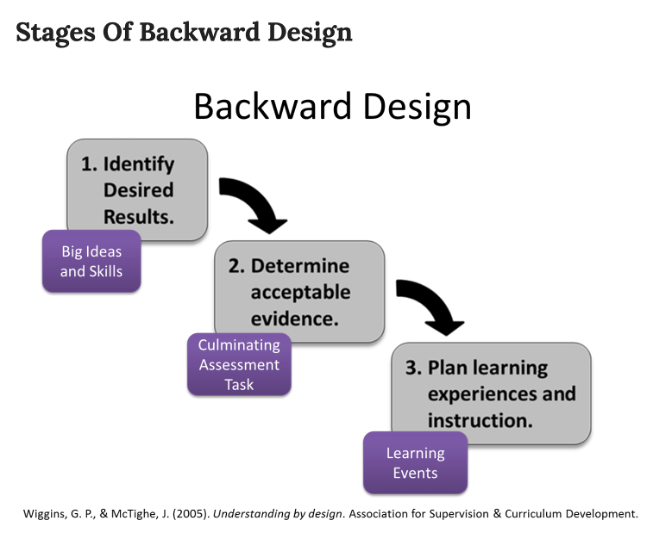
In language education there are several instruments used for backward design. The most widely used internationally is the CEFR. Other examples include the US ACTFL Guidelines, developed in the 1980s, and the Canadian Language Benchmarks.
Backward design occurs at a curriculum level, in the design of textbooks, and at a classroom level when teachers design or adopt didactic modules (sequences of several lessons), sometimes contextualized through an action-oriented scenario. The descriptors are (or should be) used to communicate aims to students, offering a ‘feed forward’ to complement the more conventional feedback that teachers generally offer.
Backward design is thus very much related to the CEFR concept of ‘transparency and coherence’ transparency of aims and achievement through the descriptors; coherence between aims, teaching methods, and assessment procedures.
Read this short Info sheet: Transparency and coherence.
Now that you have an idea of the concept, you can decide to explore more on the backward design and on practical applications by going to Backward Design in Practice.
AALE Toolkit Home | Action-oriented Approach | Plurilingualism | Tech-mediated | AALE Infosheets Exploration