
AoA, CLT & TBLT: Similarities & Differences
 | Action-oriented Approach|Plurilingualism|Tech-mediated
Task-Based Language Teaching (TBLT) vs Action-Oriented Approach (AoA): Similarities and Differences 💡
- Both stress the development of communicative competence
- Both approaches emphasize meaningful communication and real-world language use rather than isolated grammar instruction.
- Focus on Tasks
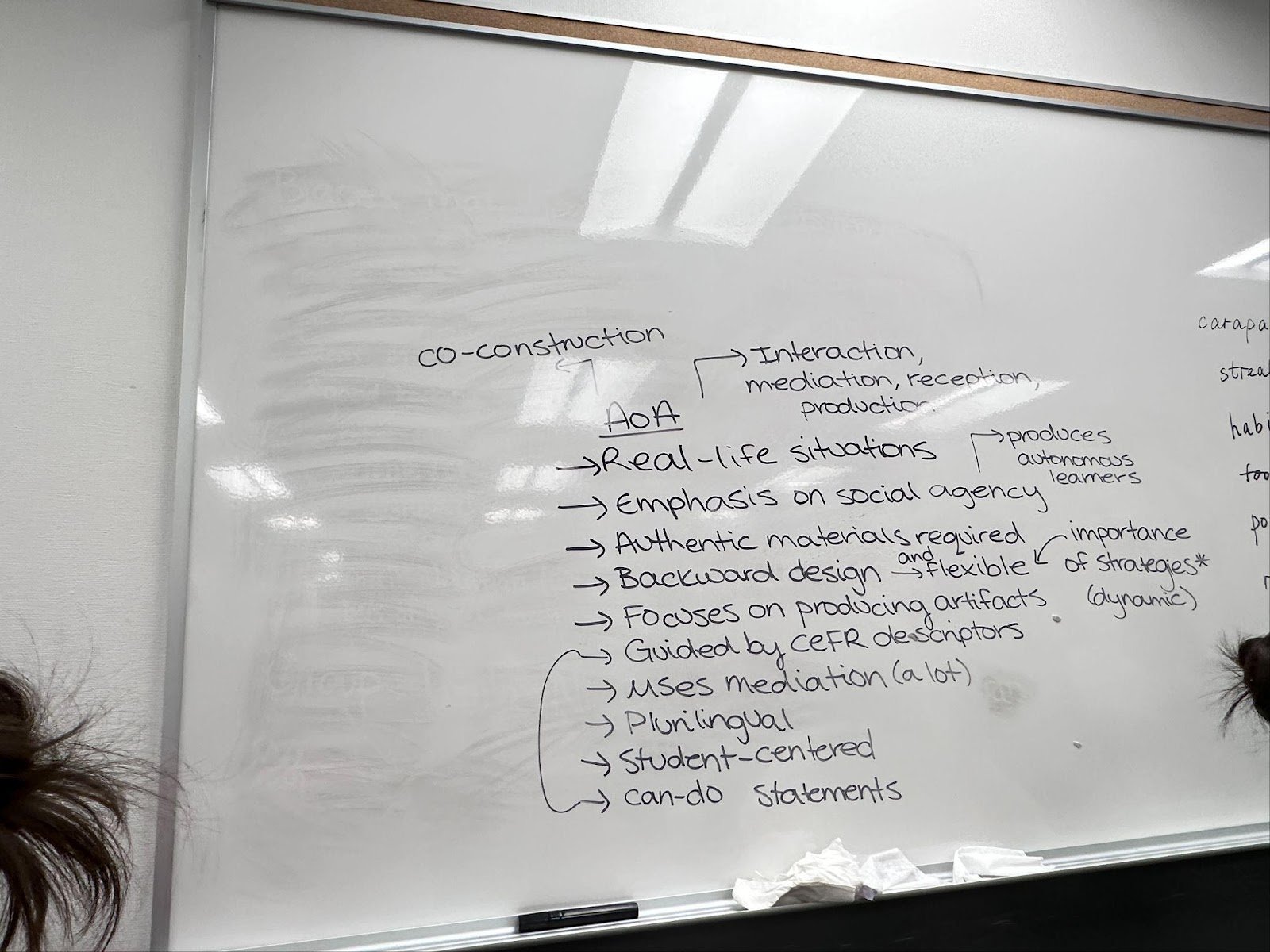
- TBLT and AoA use tasks as a primary tool for language learning. In TBLT, tasks are structured to facilitate language learning and may be quite artificial. By contrast in AoA, tasks are embedded in a broader real-life scenario. The culminating task of the scenario usually involves the production of an artifact
- Learner-Centered Approaches
- Both encourage students to actively engage with the language, rather than just passively absorb information. However, TBLT tends to structure more tightly the learning process, while in the AoA learners have more agency and take more responsibility
- Holistic Language Use
- Instead of breaking language into discrete grammatical structures, both approaches integrate multiple language skills—listening, speaking, reading, and writing—in communicative tasks. In the AoA on top of the four skills (= spoken/written reception and production) oral and written interaction and mediation of texts, concepts and communication are core.
General differences ⬅️➡️
| Feature | Task-Based Language Teaching (TBLT) | Action-Oriented Approach (AoA) |
| Theoretical Background | Rooted in Communicative Language Teaching (CLT); emphasizes task completion to develop communicative competence; may be seen as a ‘strong form’ of CLT | Takes an interdisciplinary view of language learning, integrating socio-constructivist and ecological perspectives |
| Learner | The learner is an active participant, engaging in meaningful tasks for language practice | The learner is seen as a social agent, interacting within their community to mobilise their competences in order to achieve real-world goals |
| Teacher | The teacher gives instructions, scaffolds tasks and provides corrective feedback to ensure learners successfully complete tasks | The teacher acts more as a task creator, facilitator and resource, supporting learners in co-constructing their own learning process |
| Task Design | Tasks focus on linguistic and cognitive processes (e.g., problem-solving, information exchange). Focus is on meaning more than on form | Tasks involve a broader set of actions (usually contextualised through a scenario), requiring learners to interact in a social and cultural framework AoA involves planning backwards from the culminating task, identifying what students need in order to complete it. CEFR can-do descriptors guide the definition of objectives and bring coherence between planning, teaching and assessment |
| Goals/Outcomes | TBLT measures success by task completion (e.g., a presentation, negotiation, or a written report) | AoA focuses on real-world action, requiring students to use language in socially and culturally meaningful ways. The process is as important as the product |
| Use of Scenarios | TBLT uses single tasks, which normally involve some form of interaction or collaboration to develop linguistic competence and fluency | AoA organizes learning around broader multifaceted real-world scenarios, where students make their own decisions to work independently and collaboratively aiming towards the final goal or artifact |
| Evaluation | Success is determined by linguistic performance and communicative ability within the task | Success is determined by the social impact and real-world outcome of the scenario in addition to communicative and language competences employed |
AALE Toolkit Home | Action-oriented Approach | Plurilingualism | Tech-mediated | AALE Infosheets Exploration