
Designing Affordance-rich Scenario Tasks
Now that you’ve explored what affordances are and where the concept comes from theoretically, it’s time to see how they actually look inside a real scenario. You are already creating affordances in your daily practice – the shift here is making them more action-oriented, more open-ended, and more learner-driven. That means you won’t always know exactly how your students will go about completing the task — but you can predict the kinds of interactions and language work your design will enable.
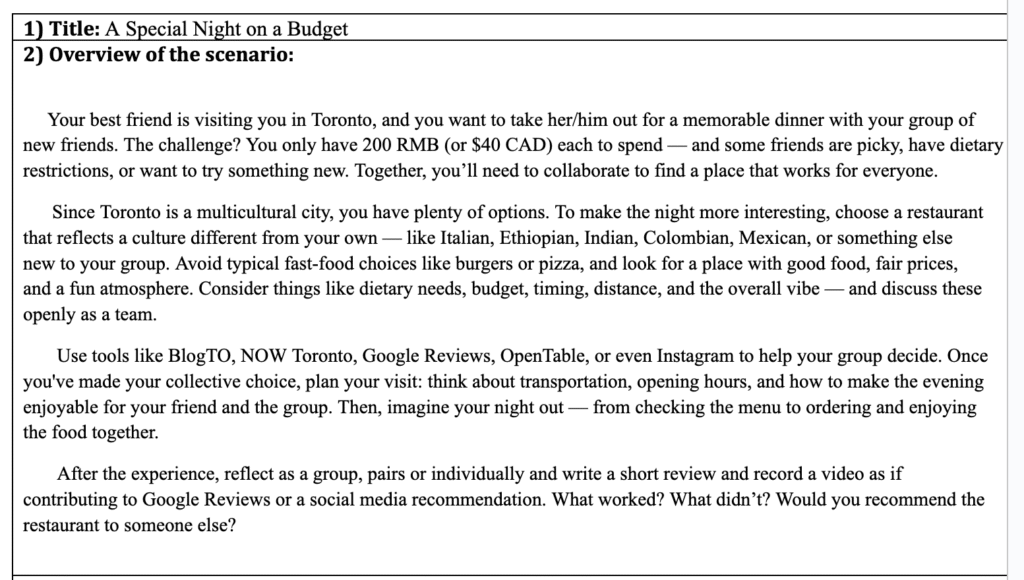
Let’s take one of our own: A Special Night on a Budget and identify (see Figure 1 for Description) where affordances are embedded, how they function, and how to intentionally replicate them in your own design.
In the walkthrough below, arrows (→) indicate the core tasks taken directly from the scenario template. Stars (★) highlight key affordance insights or alignments with CEFR descriptors.
What you are designing is not a single activity. It is a multi-phase scenario where each step creates opportunities for language use, exploration, negotiation, reflection, and meaning-making.
Setting the foundation: Scenario Description (The big picture)
The first thing a teacher must do is establish the foundation. That means looking at your curriculum, clarifying your goals, and selecting a situation grounded in the real world — something relatable, but rich enough to carry linguistic and pragmatic weight (see Backward design infosheet).
In A Special night on a budget, the teacher is planning a unit to help B1-level students with specific goals (expanding food and drink and related vocabulary; express preferences, make polite requests, etc.), for which choosing, visiting and writing about a restaurant sounds like the perfect set-up.
However, if you simply gave students a task like, “Book a restaurant and write a Yelp review”, they’d likely search for a familiar chain, make a booking in three minutes, write a short review, and be done. The task would be technically complete — but the learning opportunities would be shallow.
That’s why affordance-driven design matters. Instead of just assigning an end-product, you structure your scenario in ways that create embedded opportunities for action, language, and decision-making.
→ In this case, the scenario is authentic (a night out with friends), but you layer in constraints: a budget (e.g. $40 CAD / 200 RMB), dietary restrictions, group preferences, and the condition that they must choose a cuisine none of them has tried before. These subtle constraints generate real opportunities for negotiation, problem-solving, and intercultural thinking.
Figure 1
★ The power of the design lies in how predictable these learning moments are for you as a teacher (while still being open and engaging for the student). Students will still have full agency to choose where to go, how to present, and what to say — but your design ensures that they cannot bypass the rich, real language work.
★ Even before a restaurant has been chosen, you’ve already embedded affordances that activate vocabulary, sociopragmatics, and mediation. This is affordance design in action. Every choice they make requires language use. Every problem they solve creates opportunities for new vocabulary, sociopragmatic reflection, and mediation.
Step 1: What’s On Your Plate?” — Setting the Scene
In this scenario, Step 1 is made up of three interwoven tasks — each with affordances designed to emerge naturally through learner agency. This step doesn’t begin with restaurant research. It begins with identity, cultural reflection, and collaborative meaning-making.
Task 1: Personal Food Reflection
Ask students to reflect individually on their own food culture and eating habits. Encourage them to consider how they grew up, their favorite traditional meals, and the cultural norms around food in their home country.
Suggested prompts include:
- What ingredients are common in your country that you don’t often find in Canada?
- Is it common to eat dessert?
How many courses are typically served at dinner? - Is dinner the main meal of the day?
- How long do meals usually last, and what drinks are commonly served?, etc.
Students may take notes, jot down ideas, or write in their own language as needed.
Task 1: Food Reflection
→ The first affordance here is deeply personal. The teacher creates space for students to reflect on their own food culture — not to memorize vocabulary, but to tell stories, recall home-cooked meals, or explain what’s “normal” in their family.
★ Even if students share an L1 and come from the same country, this task invites intra-cultural variation to emerge: differences in religious practices, family customs, regional tastes, household habits. That variation fuels genuine curiosity and interaction.
★ This personal grounding brings in the affective element, engages students emotionally, and naturally prepares them to describe, compare, and reflect. They’re already generating language that matters to them and that they will need later.
★ This is not “input then output.” This is lived experience → language activation → intercultural awareness.
★ Affordances aligned with the CEFR begin to emerge here: pluricultural competence, lexical repertoire activation, and descriptive discourse.
Task 2: Interviewing Peers
→ Here, the design intentionally shifts from self-reflection to social interaction. Students now need to find out what their classmates like or dislike, consolidate what they’ve learned so far but also create another affordance: organizing and clarifying group knowledge, which will directly feed into the restaurant research step that follows:
Students interview their peers to learn about individual food preferences. This can be done in pairs or small groups and adapted to the classroom context. Students may use any tools they need to prepare the questions—dictionaries, notebooks, online vocabulary aids, etc.—to support communication. They may take notes in any format that works for them, including their own language if helpful.
Key topics include:
- Likes and dislikes
- Dietary restrictions (e.g., allergies, vegetarianism)
- Whether they are vegetarian, pescatarian, or omnivorous
- New cuisines they are curious to try
★ This isn’t a list of questions; it’s a space for real negotiation. Students now have a reason to clarify terms (“What does pescatarian mean?”), confirm differences (“Wait — you’re allergic to peanuts?”), and explore gaps in their vocabulary.
★ The affordances here are not just linguistic — they’re sociopragmatic. Respecting others’ preferences, asking sensitive questions with care, and managing group knowledge all emerge as part of authentic social interaction.
★ The CEFR communicative strategies are “lived”, i.e. experienced: asking for clarification, managing breakdowns, showing empathy, and building rapport.
Task 3: Synthesizing e-mail
→ Students are now asked to collaborate on a short group email that synthesizes what they’ve learned. In this task, we move from oral to written mediation. Students are no longer just stating opinions — they must process peer input, organize it coherently, and repackage it for a new purpose (selecting a restaurant).
Task 3: Writing a Group Email Summary
Using the information gathered in the previous tasks, students collaboratively write a short group email summarizing the food habits and preferences of their group. This will serve as a reference point to guide the restaurant selection process in the next step.
★ What we see here is the affordance of collaborative meaning-making. Students decide what matters, what’s worth including, how to express consensus, and how to keep the tone inclusive and relevant. They’re managing content and form — a core CEFR mediation skill.
★ And again, no restaurant has been chosen. But learners have already moved through personal reflection, intercultural awareness, social negotiation, and collaborative writing.
Step 2: Mapping the meal — Researching and Selecting Restaurants
→ In this second step students navigate authentic platforms (BlogTO, Yelp, Google Reviews, Instagram, OpenTable) exposing themselves to genuine multimodal input in the search of a restaurant in three inter-related tasks.
Students will now research real restaurants in Toronto based on the preferences collected in Step 1.
Task 1: Individual Research
Each student should create a personal list of 3–4 potential restaurants, including basic information such as the type of food, location, price range, and why they think the place could be a good fit for the group. Students may use any resources they find helpful—BlogTO, NOW Toronto, Yelp, Instagram, OpenTable, Pinterest, notes, or comparison charts—to organize their findings.
Task 2: Group Decision-Making
Students share their restaurant lists with the group and collaboratively decide on a shortlist of three restaurants that best meet the group’s dietary needs, preferences, and interests. Encourage discussion of which types of food appear most often, what sounds new or exciting, and how each place meets practical needs like location and price.
Task 3: Platform-Specific Research and Voice Message
Each student will choose one of the shortlisted restaurants and research it using a different platform (e.g., one student checks Yelp, another looks at Instagram, another reviews OpenTable, etc.). Then, students record a short voice message stating which restaurant they would choose and explaining why, based on their findings.
Task 1 and 2: Individual Research → Group decision-making
★ The teacher anticipates that learners will encounter real-world language: detailed customer reviews, pricing structures, descriptions of menu items, photographs of dishes, and customer reviews, etc.
★ The tasks naturally push students to decode dense, sometimes messy, real-world language.
★ These affordances here lie not only in reading and gathering information but in the cognitive work of categorizing options, evaluating suitability, and preparing to justify their selections.
★ The conversational space is intentionally designed to allow affordances for turn-taking, managing needs, preferences and adapting language register according to the social dynamics.
Task 3: Voice Message
→ To extend the mediation component, each student focuses on one venue and conducts deeper research and leaves a voice message with his/her opinion.
★ This design move creates an affordance for monologic spoken production, structure arguments, use reasoning expressions, and mediate information from diverse sources.
★ The voice message format allows students to rehearse oral communication in a familiar, authentic way — encouraging them to figure out how to express themselves naturally, rather than following textbook patterns.
Step 3: The Reservation Mission— Finalizing the Choice and Planning the Visit
→ In this third step, students move into the logistical planning stage, where affordances shift from exploration to real-world coordination across four tasks:
Finalizing the Restaurant Choice and Planning the Visit
Once students have explored their options, they must work together to choose a final restaurant and plan the logistics of the visit.
Task 1: Group Decision and Scheduling
Have students discuss their top choices and agree on a final restaurant. Then, they must decide on a suitable time for the outing.
Guide students to consider:
- Will it be lunch or dinner?
- Weekday or weekend?
- What time works for everyone?
Task 2: Checking Availability
Students use OpenTable or the restaurant’s website to check for availability. They should look at seating options (e.g., patio, high tables, bar area), dress codes, or any special notes.
Ask them to:
- Take a screenshot or photo of the reservation or availability page
- Make notes of any special requirements
Task 3: Mapping the Route
Students use Google Maps to locate the restaurant and calculate how far it is from their current location or school.
Ask them to:
- Consider travel time, transportation options, and accessibility
- Take a screenshot of the route and directions
Task 4: Practicing a Phone Call
Students practice making a phone call to the restaurant. To prepare, students may write a short script. They can carry out this task using their cellphones and apps such as WhatsApp, Discord, etc., and/or alternatively, perform a short role-play in class.
Situations to rehearse include:
- Asking for the address
- Checking availability for a group
Making or confirming a reservation
Students may record an audio clip (e.g., a voice message using WhatsApp or a similar app) or present the dialogue live in class.
Tasks 1 to 4: Group coordination, Checking Availability, Making a Reservation and Planning Travel
★ This micro-task activates functional language affordances around time, availability, and polite negotiation — framed in a meaningful social context. It’s a real decision with language naturally embedded in the process.
★ These tasks create affordances for service-related reading comprehension and introduce transactional, real-world input.
★ Screenshots of booking pages serve as both documentation and support digital literacy — blending language and tech fluency.
Step 4: Table Ready —Exploring the Menu and Practicing Restaurant Interaction
→ Step 4 transitions from planning into simulation, offering a rich array of affordances for vocabulary development, interaction, and pragmatic rehearsal across two tasks:
Exploring the Menu and Practicing Restaurant Interaction
In this step, students will explore the menu of the chosen restaurant, build vocabulary, and rehearse how to interact politely and effectively with waitstaff.
Task 1: Menu Exploration and Meal Planning
Students examine the restaurant menu and identify dishes they understand or don’t recognize. Encourage them to explore cultural aspects of the food as well.
Ask students to consider:
- What are the ingredients in each dish?
- Are there vegetarian or vegan options?
What meals are typical of this restaurant’s culture? - Are there dishes they’ve never tried before?, etc.
These questions are not meant to be a checklist, they act like prompts to encourage exploration and reflection.
After the reflection and research, students must:
- Plan what they would order for themselves and what their friends might like
- Stay within a 200 RMB / $40 CAD budget (Can they share dishes to save money?)
- Write down their meal plan: starter, main, dessert, and drink (or any combination), etc
Task 2: Practicing Restaurant Interaction
Students will rehearse how to place an order and respond to typical questions from waitstaff. They are free to choose how they want to rehearse—this could include working in pairs or small groups, writing a script first, improvising, or role-playing.
Encourage students to cover the following key interaction points:
- Making polite requests (e.g., “Could I have the vegetarian option?”, “No onions, please.”)
- Communicating dietary restrictions or personal preferences
- Asking for clarification (e.g., “What’s in this dish?”, “How spicy is it?”, “Is this gluten-free?”)
The goal is to allow students flexibility in how they prepare while ensuring they rehearse useful, authentic expressions for the restaurant setting.
Prepare them to respond to typical questions from waitstaff such as:
Are you ready to order? Can I get you something to drink? Would you like any appetizers? How would you like that cooked? Is everything okay with your meal? Would you like the bill?”
Remind them to use polite language, for example:
- “Hi, how are you today? “Good morning… “We’d like a table for four, please”.
- “Thanks so much! Everything looks great.”
- “The food was delicious, thank you. Have a great night!”
Also remind them to include tipping customs where appropriate.
Tasks 1 and 2: Making Meal Choices and Service Interaction
★ Here, the affordances are at the lexical and intercultural levels, culinary terminology that could require contextual inference or quick research.
★ The budget constraint also generates affordances for negotiation, comparative forms (“That’s cheaper but looks smaller”), and reasoning (“We could share a main and each get our own appetizer”), etc.
★ The task offers multiple layers of interaction that mirror real-world restaurant decision-making.
★ These open tasks embed multiple opportunities for sociopragmatic and linguistic development. Students may write a script, or memorize lines, manage turns, use politeness strategies, register control, etc.
Step 5: The Inner Food Critic—Reflection and Review
→ Now, students are ready to complete the culminating task — one that consolidates the building blocks developed throughout the scenario. This final step is made tangible through two integrated tasks. First, students compose a short review, modeled after platforms like Yelp, Google Reviews, or BlogTO, using familiar evaluative categories. Then, to complement their written work, they create a short video reflection, framed as if sharing a restaurant recommendation on social media:
Students are expected to review and reflect on their dining experience through both written and spoken output.
Task 1 – Written Review (Yelp-style)
Ask students to write a short online-style review (4–6 sentences) using the following categories as prompts:
- Food
- Service
- Ambience
- Price
- Location
They may also assign a star rating from 1 to 5.
Task 2 – Video Review
Students record a short video (maximum 1.5 minutes) where they reflect on their experience. This can be done individually or in groups. They should address at least four of the five categories listed above. Encourage them to include photos or screenshots (e.g., menu, Google Maps, Instagram posts) to enhance their presentation.
Task 1 and 2: Writing a Restaurant Review and Creating a Video Reflection
★ The scenario shifts into reflective and production-oriented work.
★ These tasks offer multiple possibilities for students. Students engage oral production, visual storytelling, and digital literacy.
★ The reflective format invites them to narrate their choices, justify their preferences, and mediate their restaurant experience for an external audience.
★ The use of social media makes the step very action-oriented. This group ages is between 18-20, most likely that is what they already do in their real lives when going to a restaurant.